● Cancer Neurotechnology Lab · Imperial College London
Measuring the living tumour–brain interface
Brain tumours grow inside active neural tissue. We build neural interfaces and combine electrophysiology, electrochemistry, impedance, spectroscopy and computation to study how tumour and brain influence one another, and how that interaction can be measured in ways that matter.
- Cancer neurotechnology
- Neural interfacing
- Brain–computer interfaces
- Neuromorphic BCI
- Translational neurotechnology
[01] The question
What can living tissue tell us at the point of measurement?
Anatomical imaging and molecular analysis give essential views of brain tumours. On their own, they do not describe every aspect of how tissue functions as it changes in space and time.
We study electrical and physicochemical signals across the tumour core, its boundary, infiltrated tissue and the surrounding brain. We want to know which measurements are reproducible, how signals from different physical domains relate to one another, and whether together they add useful functional information to established approaches.
[02] Research
Five lines of enquiry
01
The electrophysiology of glioma
We investigate how gliomas and their local environment are associated with changes in neuronal and tissue-level activity, how these changes vary across spatial regions and experimental contexts, and which features can be measured consistently.
Active research02
Multimodal tissue measurement
No single signal provides a complete description of living tissue. We combine electrical recording with electrochemical, impedance, optical and spectroscopic measurements, then use computational analysis to examine how they relate.
Active research03
Neural interfaces
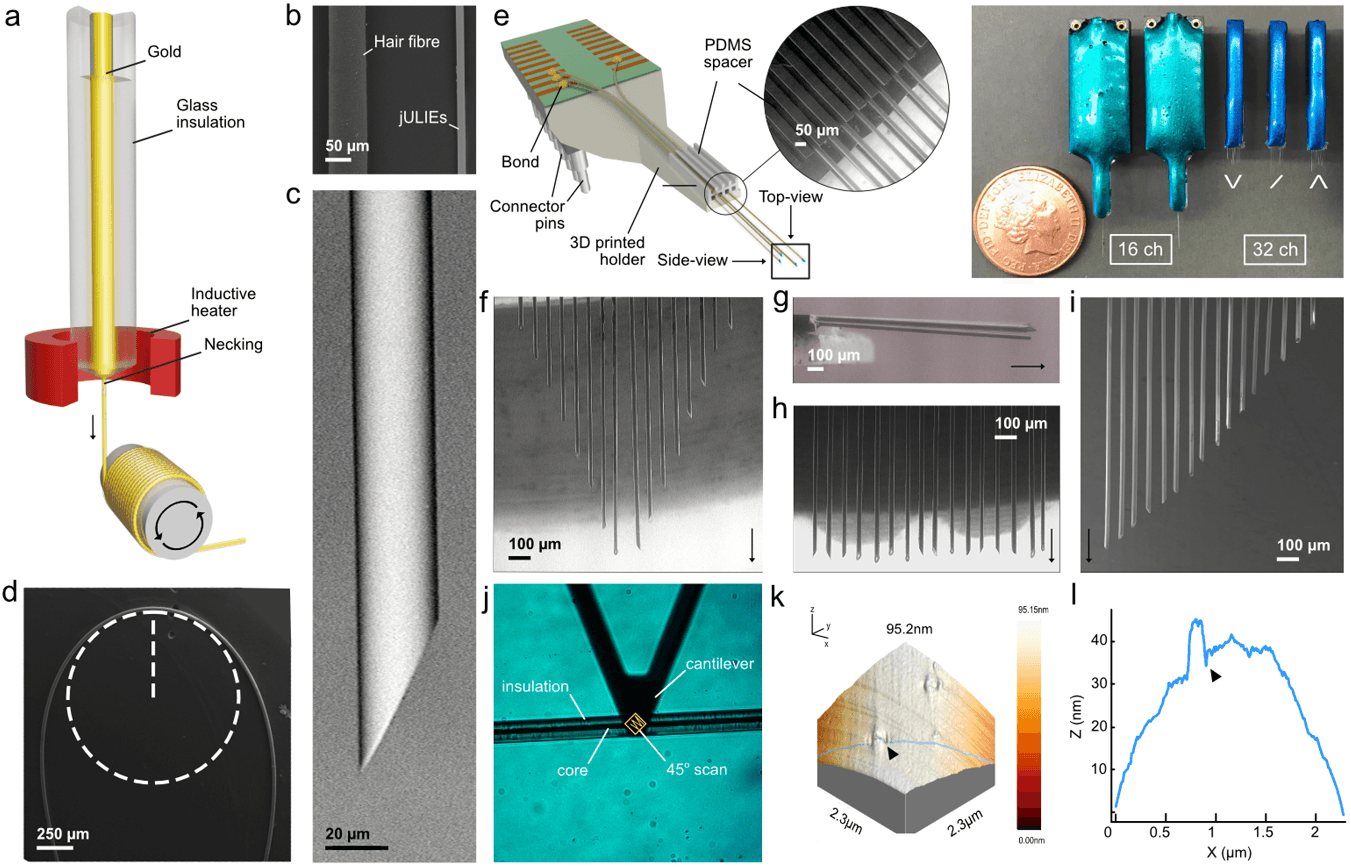
Our technical foundation is the development of small, scalable interfaces for recording from and stimulating the nervous system while limiting disruption to the tissue being studied. Published work includes jULIEs and CHIME, developed with collaborators.
Peer-reviewed foundations04
Translation by stages
We develop research platforms with clinical context in mind: practical measurement, study design, quality systems, patient and public involvement and regulatory planning. Applications in functional mapping, longitudinal monitoring and therapeutic neurotechnology remain research directions.
Long-term direction05
Neuromorphic and non-von Neumann systems
We explore computation and hardware that process neural signals closer to where they are generated: asynchronously, locally and at low power. The question is where such architectures offer a measurable advantage over conventional computing for a defined neurotechnology task.
Research direction seeking partners- Read the research programme →
[03] Current platform
GRAIL
Global Resonance Assessment & Incision Locator
GRAIL is a multimodal intraoperative research platform in development. It is designed to bring electrical and electrochemical measurements together with impedance, Raman spectroscopy and other optical or physicochemical modalities in the same neurosurgical setting.
The central research question is whether these measurements, considered together, can give a more informative account of tissue state and functional risk during brain-tumour surgery. Its clinical value remains to be established through appropriately designed studies.
Explore the technology →[04] Articles
Our research, explained
[05] Patents
Granted inventions
Visual implant
An array of micro-electrodes with nanostructured tips, driven by an integrated circuit that controls patterns of stimulation current.
Romeo-Robert Rácz, Gabriella Rácz, Andreas Schaefer
Electrochemical probe
A bundle of fine insulated wire electrodes whose tips carry an impedance-reducing nanostructure layer and a functionalisation layer, for electrochemical sensing.
Romeo-Robert Rácz, Mihaly Kollo, Andreas Schaefer
[06] Support & programmes
Supported by, and built between, institutions
- Logo
Brain Tumour Research Campaign
Programme support
- Logo
Tessa Jowell Brain Cancer Mission
Brain Tumour Research Novel Therapeutics Accelerator
- Logo
MedTech SuperConnector
Imperial College London translational programme
- Logo
The Francis Crick Institute
Research environment · Idea 2 Innovation translation support
- Logo
Cancer Research Horizons
Oncology Development Programme
- Logo
Imperial College London
Host institution
Collaborate
Have a complementary question or method?
We welcome conversations across cancer neuroscience, neural engineering, surgery, sensing, spatial biology and computation.
The Cancer Neurotechnology Lab is led by Dr Romeo R. Rácz, Advanced Research Fellow in the Faculty of Medicine at Imperial College London. The laboratory is supported by the Brain Tumour Research Campaign as a dedicated translational research programme.